Gallery 01
Cruisers & the Open Road
From the 1937 Ford Model A to the modern interceptor — eight restored Patrol vehicles trace the evolution of the cruiser, the radio, and the road itself.
Learn more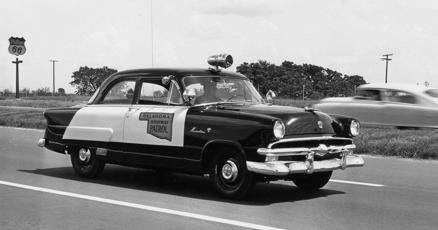
The museum is in planning, with membership and support opportunities available now. Tours, events, and expanded programs are in development and will be announced as launch milestones are met.
The Oklahoma Highway Patrol's story is the state's story — written in mile markers, badge numbers, and the men and women who carried both.
Governor E.W. Marland signs House Bill 26, establishing the Oklahoma Highway Patrol with 132 troopers tasked with policing the state's growing road network.
The Patrol's first two decades close with statewide radio dispatch, modern cruisers, and the first formal academy at the new Department of Public Safety headquarters.
Aviation, K-9, and Specialized Operations divisions are formalized, expanding the Patrol's mission across air, terrain, and the rapidly growing interstate system.
The Historical Society opens its first dedicated museum at the Marland Mansion — closing the loop between the Patrol's founder and the force he created.
Step through eight decades of state service — from historic cruisers to specialized units and an immersive historical timeline experience.
From the 1937 Ford Model A to the modern interceptor — eight restored Patrol vehicles trace the evolution of the cruiser, the radio, and the road itself.
Learn moreEight decades of insignia, hats, and standard-issue gear.
Learn moreRadios, dispatch consoles, and the wires that held the Patrol together.
Learn moreA memorial gallery for the troopers who gave their lives in service to Oklahoma.
Learn moreService sidearms, qualification standards, and training artifacts that document how safety and proficiency evolved over generations.
Learn moreField Troops, Turnpike Troops, and Commercial Motor Vehicle enforcement teams that keep Oklahoma highways safe through daily patrol and specialized inspections.
Learn moreAviation, tactical response, marine enforcement, canine operations, and other mission-critical units that extend the Patrol's reach statewide.
Learn moreA walk-through media experience blending photos, radio traffic, and oral history to place visitors inside defining Patrol moments.
Learn moreThe OHP Historical Society is a 501(c)(3) nonprofit. Membership and community support power this mission while the museum is in planning, and every gift helps preserve a valuable piece of Oklahoma history.
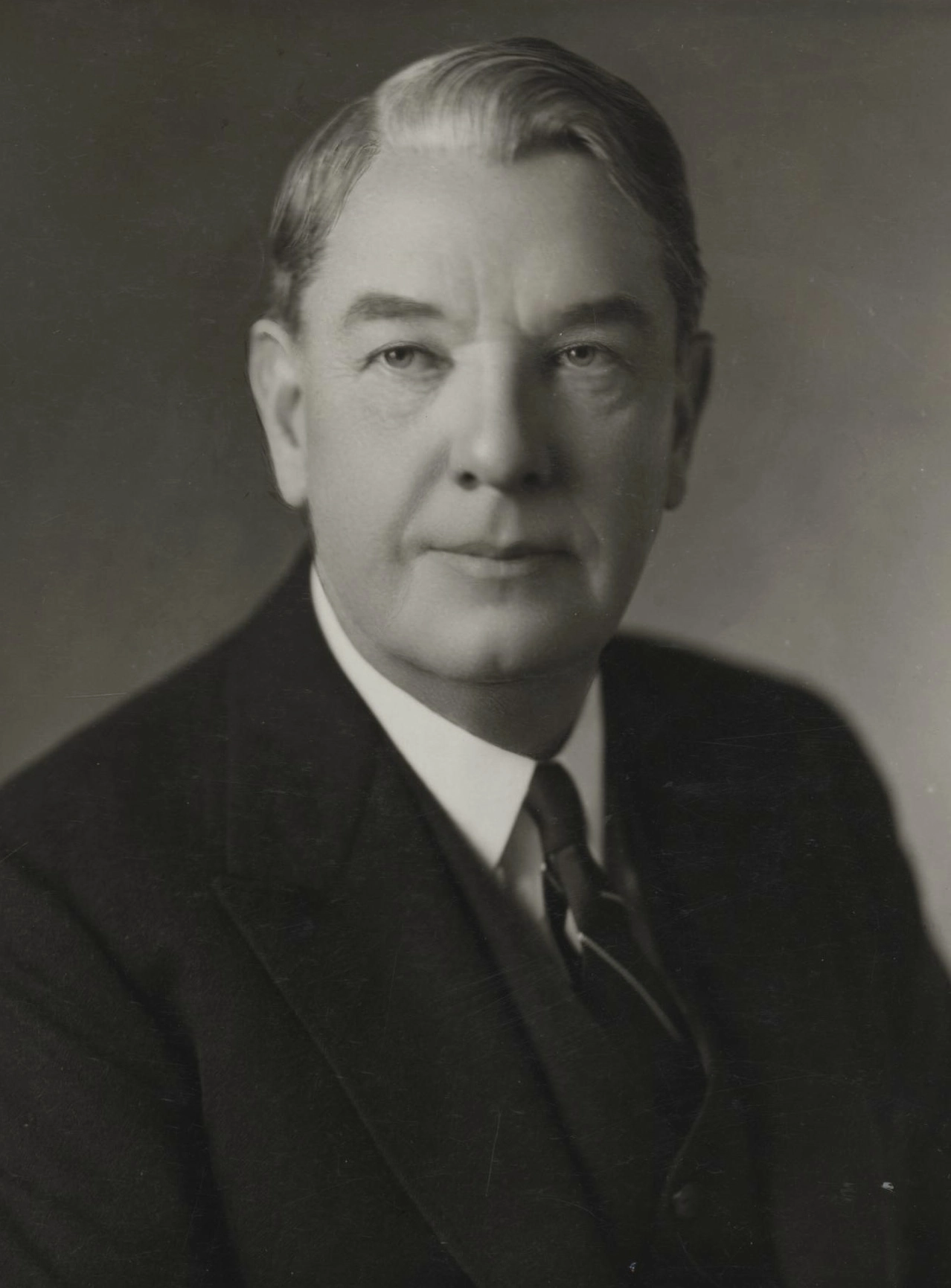
Ernest Whitworth Marland made his fortune drilling for oil in the rolling country north of Ponca City, then poured it into a Mediterranean Revival estate designed to rival the great houses of Italy. When the oil markets turned, he turned to public service — winning the governorship in 1934 and, three years later, signing the bill that put a uniformed patrol on every Oklahoma highway.
For nearly nine decades, the mansion he built and the Patrol he founded have stood as parallel landmarks of the state. In 2026, they share an address.
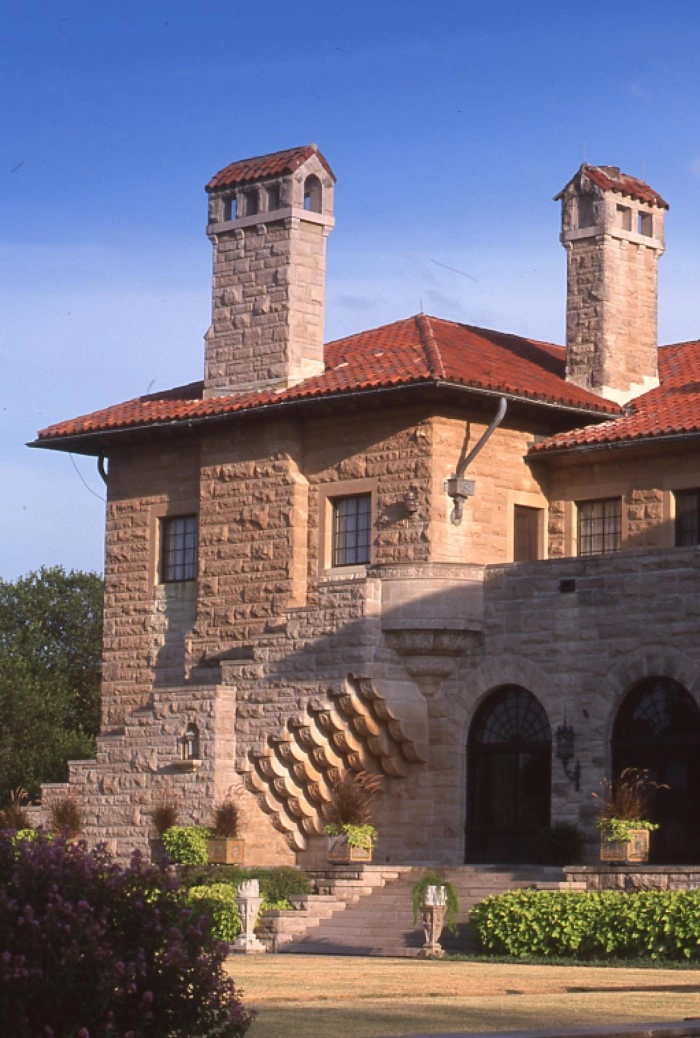
The E.W. Marland Mansion stands at 901 Monument Road in Ponca City — a 43,561-square-foot Mediterranean Revival landmark built by an oilman who would become Oklahoma's tenth governor. Today it serves a second purpose: home to the Oklahoma Highway Patrol Historical Society.
Inside its limestone walls, visitors trace nearly nine decades of state service — from the 1937 charter through the cars, uniforms, equipment, and personal effects of the troopers who wore the patch. Restored galleries, immersive historical media, and rotating exhibits give voice to a force that has watched over Oklahoma's roads since the model A.
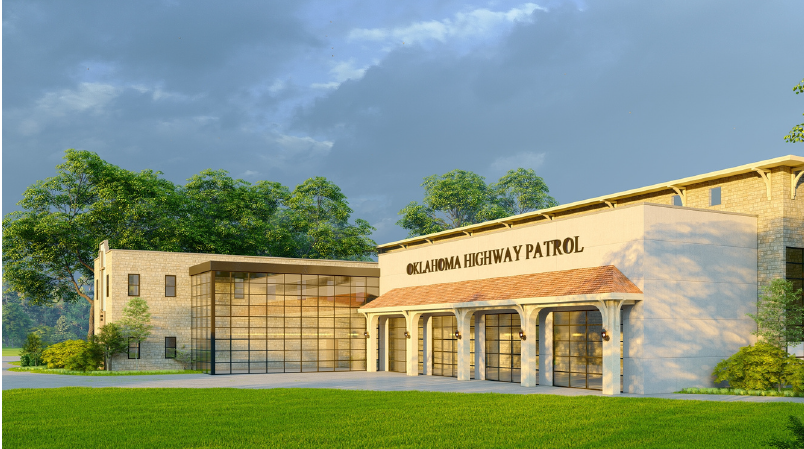
This rendering shows the proposed Oklahoma Highway Patrol Museum concept as a single-story facility focused on accessibility, visitor flow, and long-term exhibit capacity.
The design direction emphasizes welcoming public entry, dedicated gallery zones, and room for future growth while preserving the character and mission of the Historical Society.
Video loads only when clicked to keep initial page load fast.
Our board of directors is composed of retired troopers, civic leaders, historians, and supporters of Oklahoma's law-enforcement heritage. Together they steward the Society's mission, finances, and collections.
The Society's board meets quarterly at the Marland Mansion to set strategic direction, review financial stewardship, and approve new acquisitions for the permanent collection. Members serve voluntary three-year terms.
Board officers are elected each January. Standing committees include Collections & Exhibits, Finance & Audit, Membership, and Honor Roll.
Placeholder biography. Two to three short sentences describing the director's career, connection to the Patrol or the Society, and area of leadership on the board. Mention notable accomplishments, prior board service, and current civic involvement.
Closing line about why this director serves and what they hope the museum will mean for future generations of Oklahomans.
Placeholder biography. Note the director's professional background, family connection to the Highway Patrol, and the committees they chair on the Society's board.
Closing line about the director's volunteer work and ties to Ponca City or the broader Oklahoma community.
Placeholder biography. Outline the treasurer's accounting credentials, prior nonprofit board experience, and oversight of the Society's annual audit and 990 filings.
Optional second line about civic memberships, alma mater, or family ties to the Patrol.
Placeholder biography. Highlight the secretary's published work on Oklahoma history, role at the Heritage Association, and contributions to the Society's archival program.
Optional closing line about teaching, research interests, or community involvement.
Placeholder biography. Brief career summary, signature assignments, and current role chairing the Society's Collections & Exhibits committee.
Placeholder biography. Educator's background, role coordinating school field trips and youth outreach, and ties to the Ponca City community.
Placeholder biography. Director's connection to a fallen trooper, leadership of the Honor Roll memorial committee, and advocacy work for Patrol families across the state.
Placeholder biography. Professional background, philanthropic leadership in north-central Oklahoma, and chairmanship of the Society's annual giving and capital campaigns.
Placeholder biography. Official liaison between the Society and the Oklahoma Department of Public Safety. Coordinates loans of artifacts, vehicles, and archival materials from the Department's collections.
Placeholder biography. Long-tenured curator of the Marland Mansion who advises on architectural preservation, period accuracy, and integration of Society exhibits with the historic interiors.
Placeholder biography. Historian and author whose published work on Oklahoma law enforcement informs the Society's interpretive programming and oral-history initiatives.
Placeholder biography. Former commissioner whose tenure shaped modern Patrol operations. Advises the board on policy, leadership, and intergovernmental relationships.
Nominations for the next board class open each fall. We welcome candidates from across Oklahoma who share a commitment to preserving the Patrol's history and stewarding the Society's mission.
From the 1937 Ford Model A to the modern interceptor, eight restored Patrol vehicles trace the evolution of the cruiser, the radio, and the road itself — a rolling archive of how the Patrol learned to keep up with Oklahoma's highways.
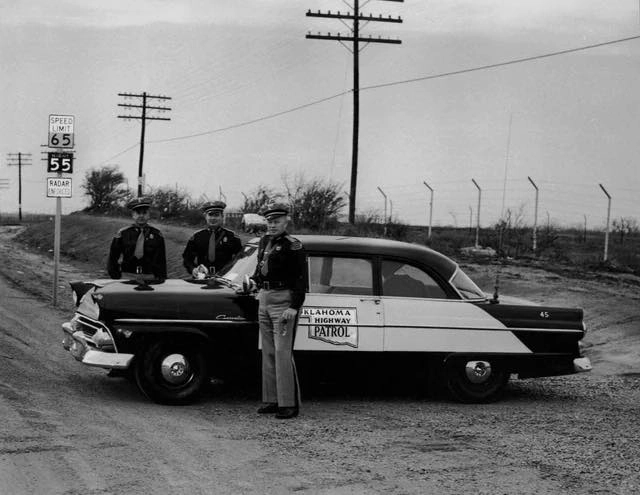
When the Patrol took to the road in 1937, troopers shared a fleet of fourteen Ford V-8 sedans — black, unmarked, and barely identifiable from the cars they pulled over. The cruiser as a public symbol — the silhouette, the lightbar, the door shield — was something the Patrol had to invent.
This gallery walks you through that invention. Each restored vehicle is paired with the year's standard-issue equipment: the radio that lived under the dashboard, the citation book on the passenger seat, the trooper's service revolver in the holster. Together they tell a story of widening responsibility — from a fourteen-man road force to a 24-hour, statewide service.
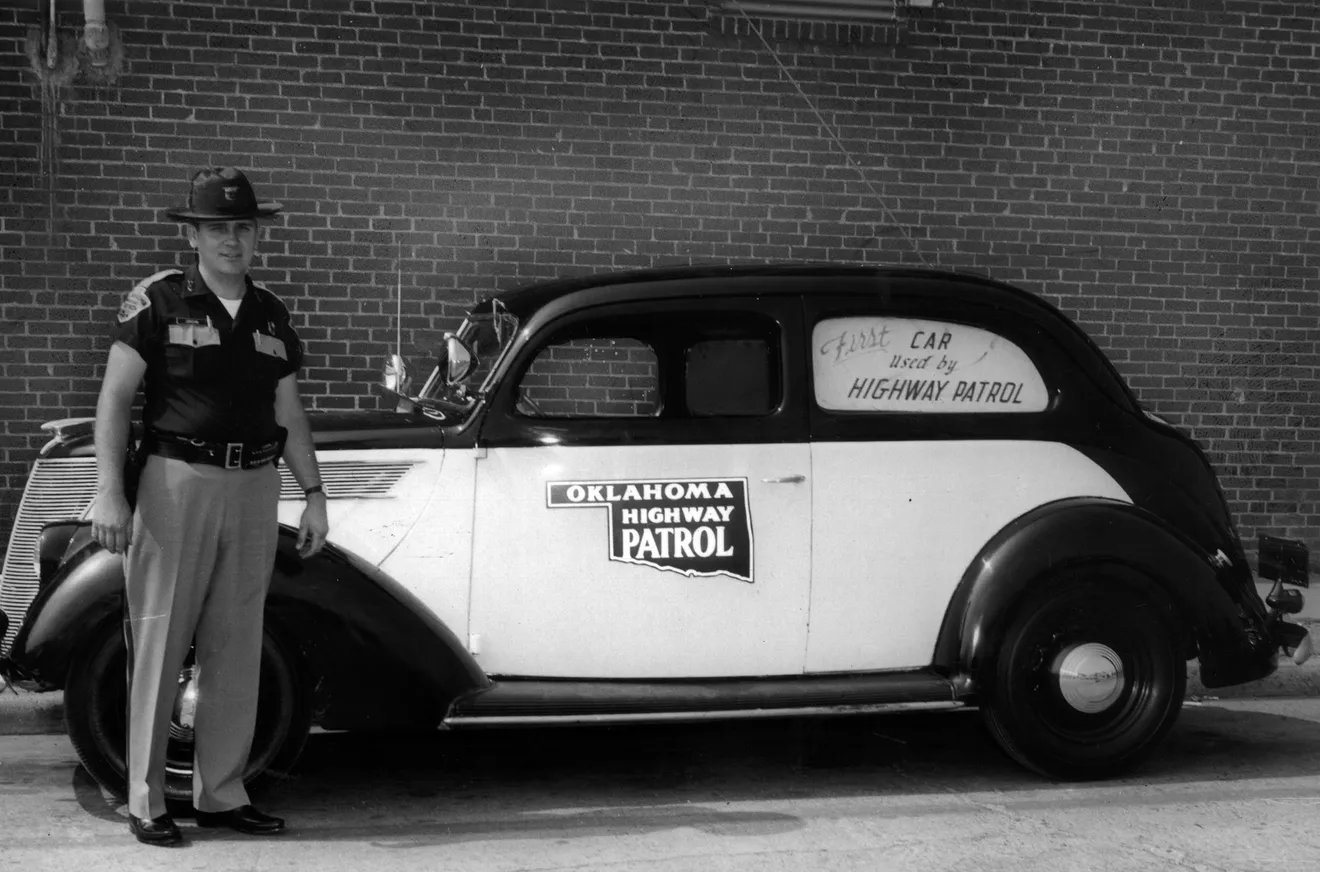
One of the original fourteen unmarked sedans issued at the Patrol's founding. Unrestored interior; Oklahoma plate "OHP-14" in original paint.
Standard-issue Patrol motorcycle, ridden by Trooper R.B. Hall on the Turner Turnpike from 1953 until his retirement in 1967.
The Patrol's first purpose-built pursuit cruiser. Donated by Tulsa County in 2009; restored over four years by volunteers.
The original red dome light, mounted on every Patrol cruiser from 1948 through 1971. Fully working; visitors may activate it.
A complete shift's worth of carbon-paper citations, recovered intact from the glovebox of a retired cruiser.
A modern interceptor in full Patrol livery, with all communication and pursuit equipment intact. Visitors may sit in the driver's seat.
The cruisers gallery occupies the original Marland carriage house, restored in 2024 to accommodate full-size vehicles. Wheelchair accessible from the south courtyard.
A working closet of the Oklahoma Highway Patrol — every cap, patch, holster, and pair of boots ever issued to a state trooper, arranged by decade so visitors can watch the uniform evolve in real time.
Every uniform decision tells a story. The 1937 Stetson said this is a state-wide force, not a sheriff's posse. The 1965 switch to the campaign hat said we are professionals, not cowboys. The mirror-shined oxford replaced the cavalry boot in 1973 because troopers spent more time on their feet than in the saddle.
This gallery lays the entire wardrobe out chronologically — patches, badges, belts, headgear — with the original tailoring orders, fabric samples, and insignia drawings. Visitors come for the uniforms; they stay for the orders that explain why each piece was changed.
One of the first hats issued to the Patrol's founding troop. Felt is intact; original sweatband signed in pencil.
A first-issue Patrol badge, hand-stamped by an Oklahoma City silversmith. Numbered 14 of the original lot of 50.
Trooper R.B. Hall's service belt — leather worn smooth where the holster rode, brass buckle re-tinned twice.
The first year of the modern campaign hat. Lighter, water-resistant, and with the four-dent crease still in regulation.
Carried at every line-of-duty funeral and at the inauguration of every Oklahoma governor since 1972.
A graduation-day tunic, worn by Trooper J.A. Boren on his pinning day. Donated by his family in 2024.
The uniform gallery occupies the original Marland family library on the ground floor. Original walnut bookcases now serve as garment cases. Level access available.
Before cell towers, before computers, the Patrol ran on a single statewide radio frequency and the voices of dispatchers who knew every trooper by car number. This gallery preserves the equipment — and the people — that made statewide service possible.
In 1937, a trooper east of Tulsa could not call a trooper west of Lawton. Statewide coordination meant pulling over at a gas station and asking to use the phone. The Patrol's first communications office was a single Western Electric console in Oklahoma City, manned around the clock by two dispatchers.
This gallery reconstructs that console, pairs it with field radios from every decade, and ends at a working modern dispatch terminal. Visitors put on a headset and listen to real (anonymized) call recordings — from a 1962 highway emergency to a 2019 weather rescue.
The original console used by Patrol HQ. Reconstructed with help from a former dispatcher; powered up daily for the audio tour.
A vehicle-mount field radio. Originally installed in cruiser No. 47; donated with the cruiser by Garfield County in 2017.
The Patrol's first transistor handheld. Visitors may pick it up — battery is removed; weight is original.
A complete day of dispatch entries from the morning of June 14, 1968. Handwritten in carbon-copy pen by Dispatcher M. Reed.
The original troop-boundary map that hung in HQ for thirty-one years. Pinholes mark every active call from 1952 to 1983.
A working modern dispatch terminal, decommissioned from Troop A in 2023. Visitors may sit and watch a recorded call replay.
The communications gallery is in the mansion's ground-floor west wing — the original Marland telephone room. Wheelchair accessible; headphones available at the listening station.
A quiet, naturally lit room set aside for the thirty-six troopers who have died in the line of duty since 1937. Visitors are asked to remove their hats and lower their voices. There is no audio tour here.
Honor Hall is the only gallery in the museum without a guided audio track. Each of the thirty-six troopers honored has a single panel — name, rank, dates, and a photograph — arranged chronologically along the curved south wall of the Marland solarium.
A folded flag, presented to the family of each fallen trooper, is on permanent loan from the families. The center of the room holds a low stone bench, the original 1937 charter framed behind glass, and a single working radio — turned to the Patrol's memorial frequency, 24 hours a day.
The first Oklahoma Highway Patrolman to die in the line of duty. Killed in a vehicle collision near El Reno during a pursuit.
Killed in the line of duty on Interstate 40, near Henryetta. His folded flag rests in the case beneath his panel.
The most recent line-of-duty death. His radio call sign is read aloud at every Patrol graduation ceremony.
Honor Hall is the ground-floor solarium of the mansion — south-facing, naturally lit, and intentionally quiet. Visitors are asked to remove their hats and silence their phones before entering. Wheelchair accessible.
A multi-sensory experience that combines archival visuals, oral histories, and dispatch audio to place visitors inside defining moments of Oklahoma Highway Patrol history.
The Immersive Historical Timeline blends photography, period audio, and oral testimony into a scene-by-scene journey through the Patrol's development. Each segment is based on verified records and curated to connect policy, equipment, and service outcomes.
Visitors move through major eras at their own pace, hearing first-person recollections while visual timelines highlight how the Patrol adapted to new roads, new technology, and new responsibilities.
Opening sequence on the Patrol's creation and first statewide responsibilities.
How roadway growth and communications changes reshaped operations.
The emergence of K-9, aviation, and advanced response capabilities.
A closing reflection on continuity, sacrifice, and current mission focus.
The Immersive Historical Timeline occupies a dedicated walk-through corridor designed for paced, self-guided viewing. Wheelchair-accessible path and seating alcoves are provided throughout.